Home · Blog · Safety and guest records
Fire safety for holiday lets, B&Bs and guest houses: the risk assessment, alarms and certificates you need

Dmitrij Sitki · lead engineer at ReceptionGO
Published 21 October 2026 · 8 min read
General information, not legal or tax advice. Check your own case with your local council, HMRC or the relevant revenue authority, or an accountant.
Any property that takes paying guests — a holiday cottage, an Airbnb flat, a B&B or a glamping pod — is covered by fire safety law. In England and Wales the Regulatory Reform (Fire Safety) Order 2005 requires a written fire risk assessment, suitable alarms, safe escape routes and information for guests. Gas appliances need an annual Gas Safe check.
Fire safety is the one area where holiday lets have been regulated all along. The rules did not arrive with registration or licensing; they have applied since 2006 to anyone who lets accommodation to paying guests. What has changed recently is the enforcement mood (fire services have stepped up visits to holiday lets after several serious fires) and the detail of what is expected, set out in the government’s guide for small paying guest accommodation.
Which law applies where
| Nation | Fire safety law | Enforced by |
|---|---|---|
| England and Wales | Regulatory Reform (Fire Safety) Order 2005 | Fire and rescue services |
| Scotland | Fire (Scotland) Act 2005 + short-term let licence conditions | Scottish Fire and Rescue Service, councils |
| Northern Ireland | Fire and Rescue Services (NI) Order 2006 | NI Fire & Rescue Service |
All three expect the same core: a fire risk assessment by the “responsible person” (you, or your managing agent), sensible precautions based on it, and information for guests.
The government’s small paying guest guide
In England, the guide Making your small paying guest accommodation safe from fire is the benchmark for smaller properties. It covers a single property with a ground floor, or ground and first floor, sleeping up to 10 people, with no more than four bedrooms on the first floor, plus most individual flats. Its January 2025 update brought in glamping pods, shepherd’s huts and yurts. Larger or more complex buildings — three storeys, more beds, a guest house with a bar — follow the full sleeping accommodation guidance and usually need a professional assessor.
The fire risk assessment in five steps
- Hazards. Kitchens, open fires and wood burners, portable heaters, candles, phone chargers in bedrooms, barbecues on decking, stored logs and fuel.
- People. Guests are asleep in a building they do not know. Think about children, older guests and anyone who cannot hear an alarm or use stairs.
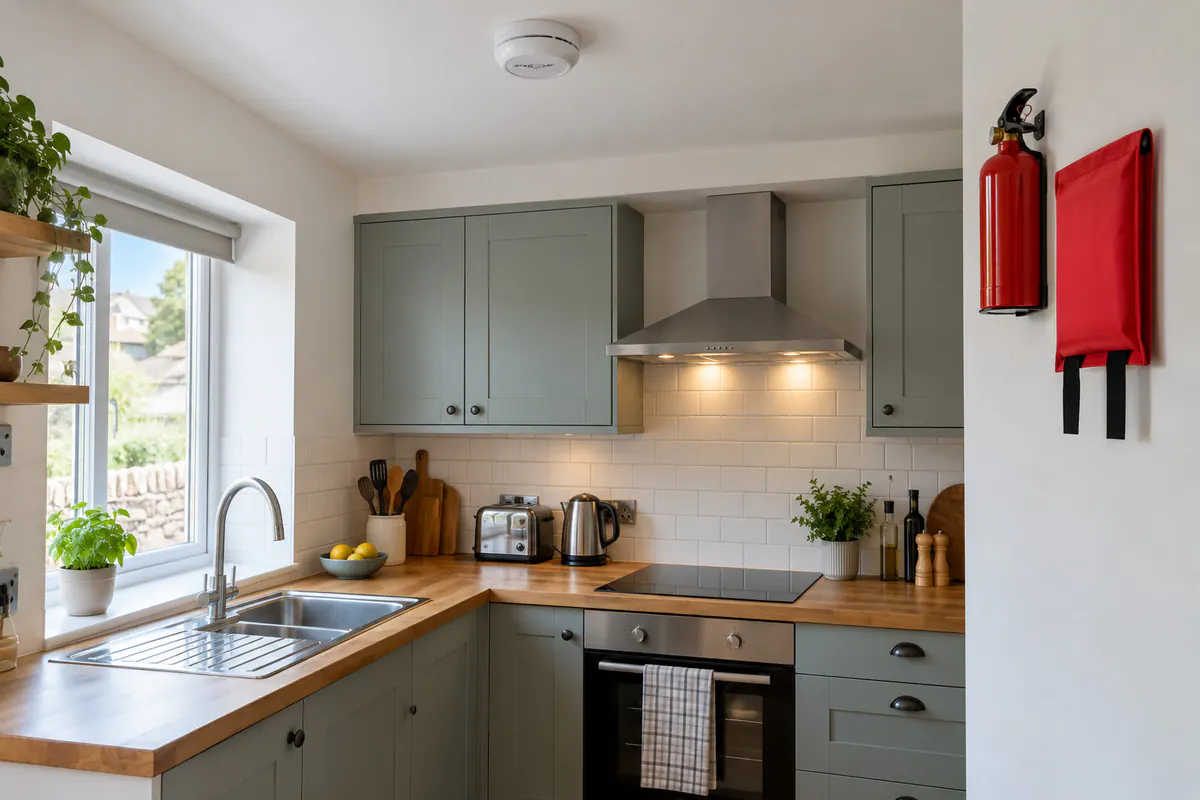
- Precautions. Alarms, a protected escape route, doors that close properly, a fire blanket in the kitchen, escape windows that open without a key, and no locked doors on the way out.
- Record and inform. Since 1 October 2023 the whole assessment must be recorded in writing, with the name of the person who carried it out. Guests must get the relevant information — what to do if the alarm sounds, the way out, where to go.
- Review. Once a year, and whenever something changes: a new wood burner, an extra sofa bed, a loft conversion.
Alarms: what the guidance expects
- Smoke alarms, mains-powered with battery backup and interlinked, in the hallway or landing on every floor and in each bedroom, for most properties.
- Heat alarm in the kitchen (a smoke alarm there causes false alarms).
- Carbon monoxide alarm in every room with a fuel-burning appliance — gas boiler, wood burner, multi-fuel stove.
- Test weekly while you prepare the property between stays, and record it.
Gas, electrical and furniture
- Gas: an annual safety check of every appliance and flue by a Gas Safe registered engineer, with the record kept for two years and available to guests. This applies to holiday lets under the Gas Safety (Installation and Use) Regulations 1998.
- Electrical: an EICR at least every five years and PAT testing of appliances guests use. Mandatory in Scotland; in England the expected standard, and asked for by insurers.
- Furniture: upholstery and mattresses must meet the Furniture and Furnishings (Fire) (Safety) Regulations 1988 — keep the labels.
- Wood burners and chimneys: sweep at least once a year, a CO alarm in the room, a fireguard if children may stay.
Information guests must have
A laminated sheet on the back of the door is the classic answer, and still a good one. But guests read what they receive before they arrive far more than what is pinned in the hall. Put the essentials in the arrival information as well:
- what the alarm sounds like and what to do when it goes off;
- the escape route from each bedroom and where the keys to escape windows are, if any;
- where to assemble outside and the address to give to 999;
- no candles, no smoking indoors, no barbecues on the decking;
- the maximum number of guests — overcrowding is the classic way a safe property becomes an unsafe one.
Licensing and registration lean on this
In Scotland the fire, gas and electrical paperwork is a condition of the short-term let licence. England’s coming register is designed to help councils enforce exactly these rules — see short-term let registration in England. Get the risk assessment and certificates in order once, and both become forms rather than projects.
Frequently asked questions
Do I need a fire risk assessment for a holiday let?
Yes. Since 2006 every holiday let, B&B and guest house in England and Wales has needed one, and since 1 October 2023 it must be recorded in writing in full, with the name of the person who did it. You can do it yourself for a simple property using the government’s small paying guest guidance, or use a competent assessor.
Which smoke alarms does a holiday let need?
For most small properties the government guide expects mains-powered, interlinked smoke alarms in the escape route on every floor and in bedrooms, and a heat alarm in the kitchen. Battery alarms are acceptable only in limited, very simple cases. A carbon monoxide alarm is needed in every room with a fuel-burning appliance, including wood burners.
Is a gas safety certificate required for a holiday let?
Yes. The Gas Safety (Installation and Use) Regulations 1998 apply to holiday accommodation: every gas appliance and flue must be checked every 12 months by a Gas Safe registered engineer, and the record kept and made available to guests.
Is an EICR mandatory for holiday lets?
In Scotland, yes — it is a licence condition, along with PAT testing. In England the EICR rules for private rented homes apply to tenancies, not holiday lets, but the government’s holiday let guidance points to the same standard and insurers usually expect it.
Does the guidance cover glamping pods and shepherd’s huts?
Yes. The January 2025 update of the government’s small paying guest guide added glamping pods, shepherd’s huts and yurts to the types of accommodation it covers.
Try it free
30 days, no commitment and no card. Setup takes minutes, and we help you personally with the first steps.
Start freeSources
- GOV.UK — Making your small paying guest accommodation safe from fire (updated January 2025)
- Regulatory Reform (Fire Safety) Order 2005
- HSE — Gas safety in holiday accommodation (landlords’ duties)
- mygov.scot — Legal requirements for short-term let licences (fire, gas, electrical)
- GOV.UK — Letting out a self-catering holiday home in England: rules and regulations
- Tourism NI — Fire safety regulations for your business (Fire and Rescue Services (NI) Order 2006)
- NIFRS — Small bed and breakfast premises fire safety guide (March 2025)
Rules last checked on 15 October 2026.