What a Front Desk Really Costs a Small Hotel — and the ROI of Automation
Ask a small hotelier what their reception costs and they'll quote a salary. The real number is bigger: night coverage, the owner's own unpaid hours, admin errors, and the revenue quietly lost while nobody answers messages. Here's the full accounting — and the honest math of replacing most of it with software.
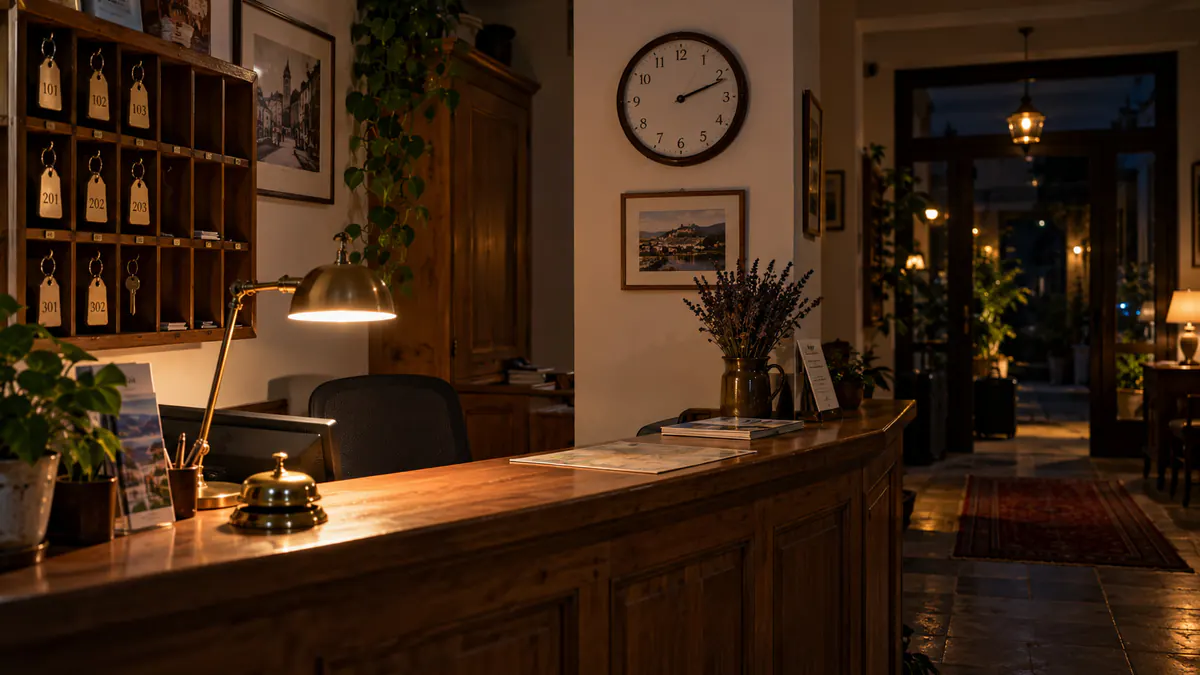
The visible cost: wages
Keeping one desk staffed 24/7 is not one salary — it's roughly 4.2 full-time positions once you cover three shifts, weekends, holidays, vacation and sick leave. Even a modest European wage of €1,600–2,200 gross/month per receptionist puts a true 24/7 desk at €90,000–130,000 a year with employer costs. That's why almost no property under ~40 rooms actually runs one — instead they run the cheaper, more painful alternative: the owner is the night shift.
For the typical 5–25 unit property the "front desk" is really a hybrid: some paid hours, plus the owner's phone ringing at all hours. The paid part shows up in accounting; the rest shows up in burnout.
The invisible cost: where the hours actually go
Track a week of reception work in a small property and it decomposes into a handful of repeating tasks — almost all of which are rule-based, which is to say automatable:
Thirty-plus hours a week, in season, of work that follows fixed rules. At even €12/hour of imputed cost, that's €1,600–1,900 a month — before valuing the owner's evenings at anything, which is the actual currency being spent.
The third cost: what manual reception loses
- Missed inquiries = missed bookings. Prospects who message at night and hear back in the morning have often already booked elsewhere. Slow OTA response times also depress ranking, compounding quietly.
- Compliance slips. Late guest registrations carry fines of hundreds of euros per incident; manual processes slip precisely during the busiest (highest-revenue) weeks.
- Payment leakage. Unpaid balances and uncollected city tax from "we'll sort it at checkout" moments that never happen.
- Review erosion. "Had to wait for check-in", "nobody answered" — avoidable one-star themes that cost future revenue via ranking and conversion.
The automation side of the ledger
Now the other column. A modern reception-automation stack for a small property consists of:
- Software — online check-in with ID verification, automatic government reporting, payments and city tax, door-code management, an AI assistant for guest messages, and booking sync across channels. As one integrated platform (like ReceptionGO): from €7.99/month for a small property, scaling with capacity — typically €50–150/month for a 10–25 unit operation.
- Hardware — one-time: keypad smart locks at €80–120 per door plus a gateway or two. For 12 doors: roughly €1,200–1,600, once.
A worked example
A 12-unit apartment hotel, 65% average occupancy, 2-night average stay — about 120 arrivals a month in season.
| Item | Manual | Automated |
|---|---|---|
| Arrival handling (120 × ~8 min + waiting windows) | ~45 h/month | ~2 h/month (exceptions) |
| Guest registration + tourist tax filing | ~20 h/month | 0 (automatic) |
| Guest messaging | ~50 h/month, response in 30–90 min | ~4 h/month (escalations), response in seconds |
| Balance & city tax collection | Leaky, chased at checkout | Collected before code release |
| Night arrivals | Owner on call | Non-event |
| Cost | ≈ €1,700/month equivalent | ≈ €160/month all-in |
Payback on the lock hardware lands in month one or two; from then on the delta — call it €1,500 a month — is either recovered margin or recovered life, depending on whether the hours were paid or the owner's own. And this is before counting recovered revenue from faster inquiry responses and upsells, which for many properties exceeds the cost savings.
What automation does not replace
Honesty makes the case stronger, so: automation does not clean rooms, fix boilers, or comfort a guest whose luggage the airline lost. It does not replace the judgment calls — refunds, damages, the neighbor complaint. What it does is strip away the 90% of reception that is clerical, so the remaining 10% gets a calmer, better-rested human. Properties that frame it this way to their teams get adoption; properties that frame it as "replacing Maria" get sabotage. The desk disappears; the hospitality doesn't.
Run the numbers on your property
ReceptionGO automates check-in, ID verification, government reporting, payments, door codes and guest messaging — from €7.99/month, priced by your capacity, live in minutes.
Start free