Hotel Self Check-In: The Complete Guide for 2026
Guests already board planes, rent cars and pick up parcels without talking to anyone. Checking into a hotel is the last place they still queue at a desk. This guide explains how online self check-in works end to end — ID verification, payment, guest registration and door access — and what it actually changes for a hotelier's day.
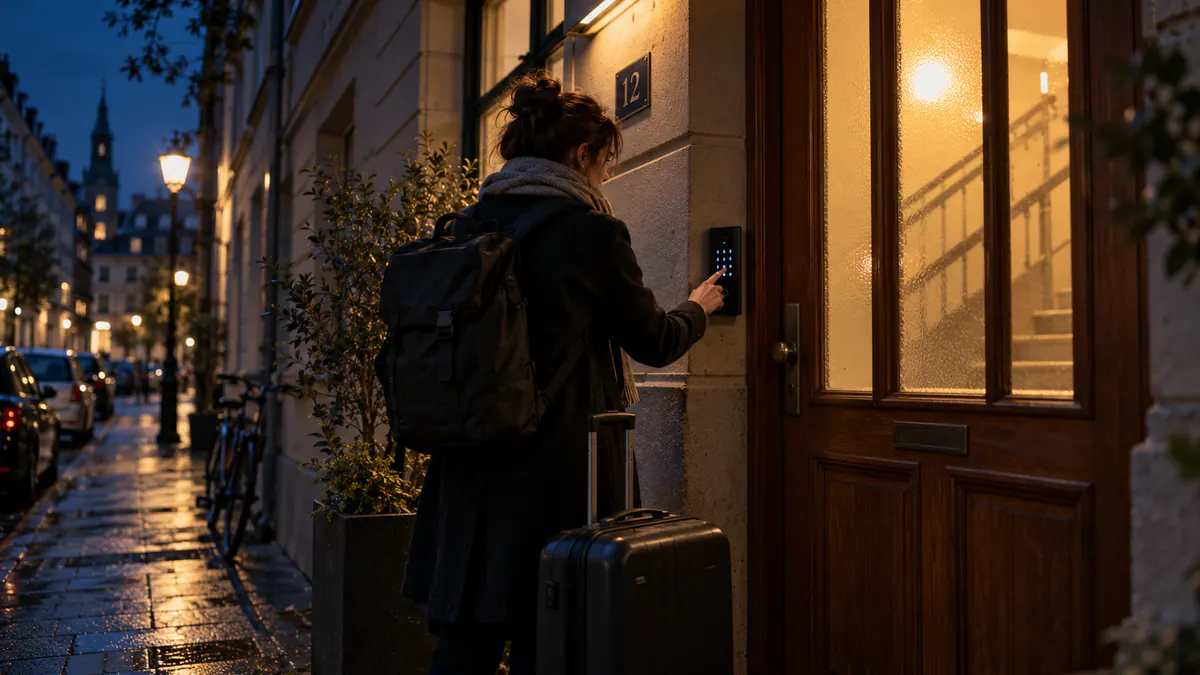
What is hotel self check-in?
Self check-in (also called online check-in, contactless check-in, digital check-in or remote check-in) is a process where the guest completes every arrival formality before they reach the property: they accept the house rules, verify their identity with a passport or ID card, pay any outstanding balance and tourist tax, and receive access to the room — usually as a PIN code for a smart lock or a mobile key.
For a hotel, guesthouse, apartment or vacation rental, that means arrival stops being an event that requires a person behind a desk. The reservation flows in from Booking.com, Airbnb, Expedia or your direct channel; the guest gets a check-in link; and by the time they stand in front of the door, everything — including the legally required guest report to the authorities — is already done.
Why hoteliers are switching in 2026
The pressure comes from three directions at once:
- Labor. Hospitality staffing is the single biggest operational headache for small and mid-sized properties. A 24/7 reception means at least three shifts of wages for a task that is, most of the day, waiting.
- Guests. Arrival times are unpredictable — late flights, road delays, "we'll be there around midnight". Every late arrival is either a staff member kept on duty or an awkward key-in-a-lockbox workaround.
- Compliance. Nearly every European country requires accommodation providers to register foreign guests with the police or a national tourism registry, often within 24 hours. Doing this by hand, per guest, every day, is unpaid administrative work with fines attached.
Self check-in software collapses all three: the desk work disappears, arrival time stops mattering, and guest registration is filed automatically the moment the ID is verified.
How much time does check-in actually take?
A traditional front-desk check-in — greeting, passport photocopying, form filling, payment terminal, key handover, directions — typically takes five to ten minutes per booking, plus the waiting time nobody measures: the hours a host spends available "just in case" a guest arrives. With online check-in, the guest does their part on their phone in a few minutes days before arrival, and the property-side work rounds to zero.
Multiply by occupancy: a 15-room property with daily turnovers spends roughly 30–60 staff-hours a month purely on arrival formalities. That is most of a part-time salary — before counting late-night arrivals.
The building blocks of a self check-in system
1. Online check-in page
The guest receives a link (by email, SMS or WhatsApp, or via the booking channel's messaging) that opens a branded check-in page. No app install — hospitality guests will not download an app for a two-night stay. The page walks them through rules, documents, payment and access instructions in their own language.
2. Identity verification (KYC)
The core of legal check-in is knowing who is actually staying. Modern systems scan the passport or ID card with the phone camera, read the MRZ (machine-readable zone), and extract name, document number, nationality and date of birth automatically. Advanced setups add liveness detection and face matching — comparing a selfie against the document photo — which closes the gap between "someone typed a name" and "we verified this person".
3. Payments and city tax
If the booking has an outstanding balance — common with OTA reservations that only guarantee the card — the check-in flow collects it before the door code is released. The same applies to tourist tax / city tax, which many countries require to be itemized per person per night. Card processing typically runs through Stripe, so the money and the compliance trail live in one place.
4. Door access: smart locks and codes
Access is where self check-in becomes physical. The most robust pattern is a keypad smart lock with per-guest PIN codes: a unique code is created for each booking, valid exactly from check-in to check-out, and deleted automatically afterwards. No key handover, no lockbox with a never-changed code, no app pairing at the door. We cover lock selection in detail in the smart lock guide.
5. Automatic guest registration
Once the ID is verified, the system files the mandatory report to the national registry — AJPES eTurizem in Slovenia, eVisitor in Croatia, Alloggiati Web in Italy, and so on — without anyone retyping passport numbers into a government portal at 11 pm. This step is where automation pays for itself fastest, because it converts a legal risk into a background job.
Mobile check-in vs. kiosk vs. hybrid
| Model | Best for | Hardware | Trade-offs |
|---|---|---|---|
| Mobile / web check-in | Apartments, vacation rentals, small hotels, hostels | Smart locks only | Guest does everything pre-arrival; virtually no capital cost |
| Lobby kiosk | Larger hotels with a physical lobby | Kiosk terminal + key card encoder | Hardware cost and maintenance; still requires guests to queue at a machine |
| Hybrid | Hotels keeping a day-time desk | Smart locks; desk for exceptions | Staff handle edge cases; automation covers nights and peaks |
For independent properties the economics strongly favor the mobile model: a keypad lock per door plus software replaces both the kiosk and the desk shift. Kiosks made sense when ID scanning required dedicated hardware; a modern phone camera does it better.
What about guests who want a human?
Self check-in doesn't mean unreachable. The properties that do this well pair the automated flow with an AI assistant on WhatsApp and other channels that answers questions instantly — "where do I park?", "I forgot the door code", "can we check in early?" — and escalates the rare genuinely-human case to the owner's phone. In practice, guests overwhelmingly prefer a two-minute phone flow over a queue, and satisfaction scores on "check-in experience" tend to rise, not fall, after going contactless.

Common concerns, honestly answered
“Is it legal to check guests in without seeing them?”
In most European jurisdictions, yes — what the law requires is that identity data is collected and reported, not that a receptionist physically inspects the passport. Digital ID capture with document verification generally satisfies the requirement; some countries (and some property categories) have specific rules, so check the national registry's guidance. Automated systems actually improve compliance because reports are filed on time, every time.
“What if the ID scan fails?”
A good flow degrades gracefully: camera scan first, manual entry with human review as fallback, and the door code is withheld until verification passes. The failure mode is a support message, not a guest on the street.
“What about security — codes floating around?”
Per-booking codes that expire at checkout are categorically safer than metal keys (which get copied and lost) or static lockbox codes (which every past guest knows). Access logs also tell you exactly which code opened which door and when.
Implementation checklist
- Connect your booking channels (Booking.com, Airbnb, Expedia, channel manager or direct) so reservations sync automatically.
- Install keypad smart locks on the main entrance and room doors.
- Configure your house rules, city tax and payment collection.
- Set up the automated guest report for your country's registry.
- Turn on guest messaging so check-in links go out automatically after booking.
- Run one test booking end to end — book, verify, pay, open the door — before going live.
With modern software this is an afternoon, not a project: no on-premise server, no PMS migration, no hardware beyond the locks.
Put your check-in on autopilot
ReceptionGO handles online check-in, ID verification, payments, door codes and government reporting for hotels, apartments and vacation rentals — live in minutes, from €7.99/month.
Start free