Home · Blog · Operations and automation
Damage bonds and cancellation policies for Australian holiday rentals

Elena Sitki · operations at GreenSLO and public relations for ReceptionGO
Published 7 November 2026 · 5 min read
General information, not legal, tax or insurance advice. Check your own case with your council, the ATO or the state revenue office, or an accountant. Rates and dates below were checked on the date shown — recheck the linked official page before you lodge, register or set a price from them.
Take a damage bond by card, name the amount, and refund it unless you can show the damage. Do not mix it into the tariff. In Victoria the levy is not charged on a damage charge. Use the same cancellation wording on Airbnb, Booking.com, Stayz and your own site. The bond is not insurance.
We set up online check-in, payments and door codes with you, free. →
The bond and the cancellation rule are where hosts get emotional and guests get screenshots. Keep them boring. A stated amount, taken by card, refunded unless you can show the damage. A cancellation sentence that is the same on every site. A Christmas week that is stricter than a Tuesday in August, said in advance. None of that requires a speech.
The bond
Call it a bond or a security bond, which is the language Australian guests expect, not a “security deposit” in a translated policy. Take it before the code goes out, as part of online check-in, so you are not chasing a card number after the fact. Keep it separate from the tariff in your records. If you are registered for GST, ask your accountant how a bond that is later retained as damages should be treated — do not invent a tax code for it here. In Victoria, the SRO is explicit that a charge for damage is not part of the booking fee on which the 7.5% levy is calculated. The rest of that tax is in the levy guide.
Refund on a timer you publish: within a set number of days of checkout, sooner if the cleaner has walked through. Silence is how a fair host looks like a slow one. The walkthrough photos are a changeover habit — linen and changeovers.
The cancellation policy
Write three lines, not a novel.
- How long before arrival they can cancel and receive what back.
- What happens inside that window, including no-shows.
- What is different in school holidays and the summer peak, if anything is.
Use those lines on the direct site and match the closest official policy on each OTA. Airbnb will still apply Airbnb’s rules to Airbnb bookings; you do not get to invent a harsher one in the app and a kinder one in the listing. Booking.com and Stayz are the same idea with different buttons. The fee those channels charge is unrelated to whether you refund the guest — fees — but a refund you process yourself on a direct booking is your cash flow, which is a reason the direct policy should be one you can explain at 9pm. See direct bookings.
School holidays and Christmas are when a vacant week cannot be resold. A stricter peak policy is reasonable if it is on the page before they pay. It is in the summer peak and school holidays. A stricter policy you then waive for the guest who writes a long email, and enforce on the guest who does not, is the one that becomes a review. Consistency is the whole trick — reviews.
Consumer law, without a law degree
Standard terms have to be fair under the Australian Consumer Law. A term that lets you keep everything in any circumstance, including when you cancel, is the sort of term the ACCC tells businesses to look at. Read the guidance, and have the policy checked if you take a lot of direct money. This page is not that check.
What the bond is not
It is not public liability insurance. It is not a substitute for a pool gate. It is not a fine for a one-star review. Serious harm is the policy you arranged before the season, described in insurance. A schoolies week or a bucks weekend is where the bond earns its keep only if the rules — occupancy, noise, no extra guests — were accepted first. Those weeks are in events and schoolies.
Frequently asked questions
How big should the bond be?
Large enough to cover a plausible accident — a broken window, a soiled mattress — and small enough that a normal guest will pay it. A bond equal to the entire stay deters the family you wanted and does not cover a fire. We are not naming a dollar figure, because the right number depends on the property. Say the number in the listing, not after they arrive.
Is a bond the same as a deposit?
No. A deposit is part of the tariff, kept according to the cancellation rule. A bond is security for damage, refunded when the place is as they found it, ordinary wear excepted. Mixing the two is how a “bond” quietly becomes income you then have to explain, including for GST if you are registered, and for the Victorian levy, which excludes damage charges from the booking fee.
Can I keep the money if they cancel?
Only under the policy you showed them before they paid, and only to the extent that policy is lawful. Australian Consumer Law cares about standard terms that are unfair. A non-refundable Christmas week, stated up front, is a different thing from “all sales are final” in tiny type after a bushfire. On Airbnb, Booking.com and Stayz the platform’s own cancellation rules also bind you. Your direct site can differ — slightly — but if it differs wildly, the guest will say you hid it.
What if they damage something and dispute the bond?
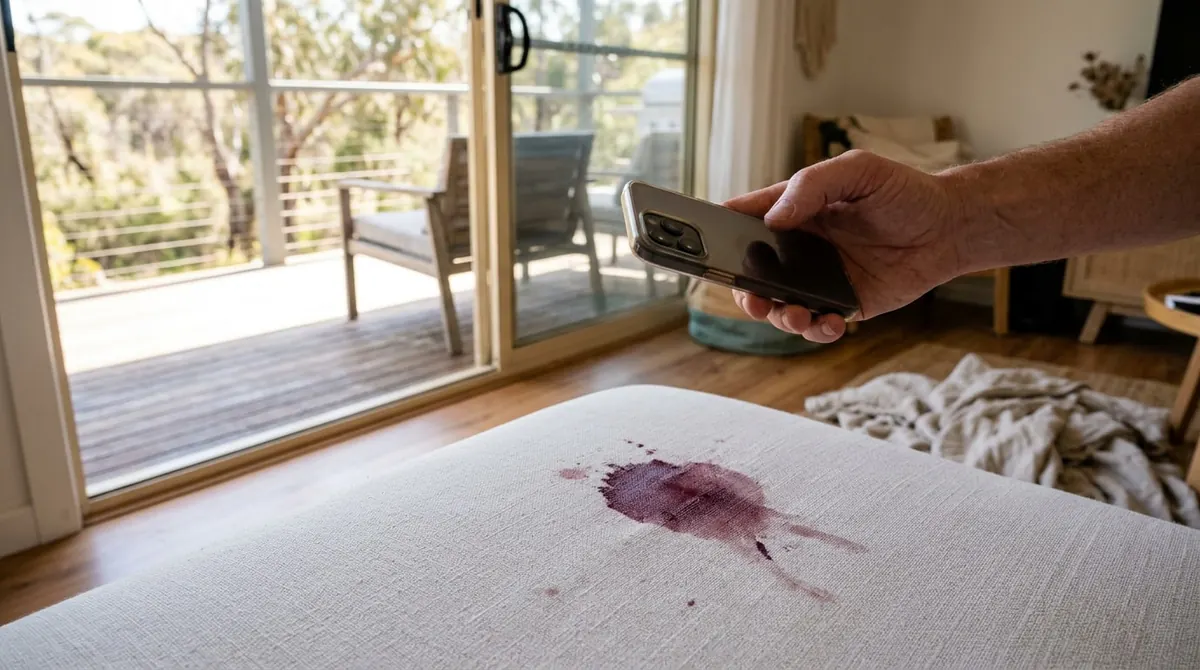
Photos from the changeover before they arrived, photos after, and the rule they accepted. Refund what you cannot evidence. A bond fight over a wine stain is cheaper than a review that says you stole the bond. Serious damage is an insurance conversation, not a $400 card hold. See the insurance guide.
Free help with setup
We connect Booking.com, Airbnb, Expedia and Stayz, Stripe and smart locks with you, and set up the check-in page. The first 30 days cost nothing, and setup help is always free.
Start freeSources
- State Revenue Office Victoria — damage charges are outside the booking fee for the levy
- Australian Consumer Law — unfair contract terms, for standard booking terms
- Airbnb — host cancellation rules (platform policy still applies on that channel)
Rules last checked on 22 October 2026.